White Paper: Elastomer Applications in AWWA Valves
To see images and tables, download the white paper PDF.
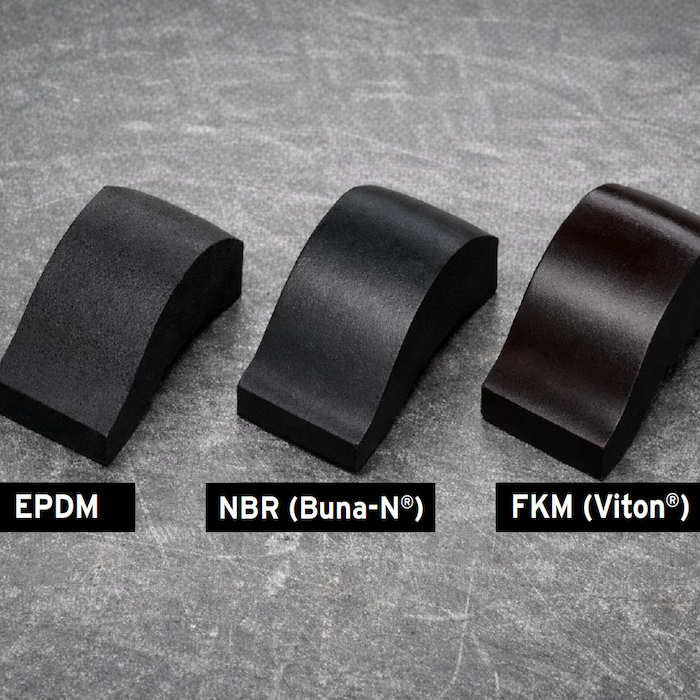
In the AWWA (American Water Works Association) valve industry, the selection of elastomers is dictated by the need for longevity, reliability, and specific environmental compatibility. There are three primary elastomers used in the waterworks industry, EPDM (Ethylene Propylene Diene Monomer), NBR (Buna-N®), and FKM (Fluorocarbon, Viton®). Each has its own key properties and primary use, with considerable overlap in certain applications. We will not discuss some less used or legacy elastomers in water and wastewater valves like Polyurethane (PU/Urethane), SBR (Styrene Butadiene Rubber), and Neoprene (CR).
ELASTOMER MANUFACTURING
EPDM, NBR (Buna-N®), and FKM are all manufactured through a three-stage process: creating the raw polymer chains via polymerization, mixing them with additives during compounding, and finally forming permanent cross-links during a heat-and-pressure process called curing (vulcanization) to achieve elasticity. The core difference between these specific types is that their initial raw polymers are made from entirely different chemical building blocks (monomers); EPDM uses ethylene/propylene, NBR (Buna-N®) uses acrylonitrile/ butadiene, and FKM uses specialized fluorinated monomers. This distinct chemical makeup necessitates different, specific curing agents and conditions for each material.
BASIC STEPS IN ELASTOMER MANUFACTURING:
- Raw Materials: Simple monomers (chemical building blocks, e.g., butadiene, ethylene, fluorinated compounds) from petrochemical sources.
- Polymerization: Monomers are chemically reacted (with peroxide, potassium persulfate, or other initiators) to form long, intertwined polymer chains, creating a basic, non-elastic raw rubber.
- Compounding: The raw polymer is mixed in specialized equipment with various additives like carbon for strength, plasticizers for flexibility, and curatives (like sulfur or peroxides).
- Shaping/Molding: The mixed, uncured compound is formed into a desired shape (e.g., sheets, tubes, o-rings) using processes such as extrusion or injection molding (encapsulating a component such as a valve plug or check valve disc).
- Curing/Vulcanization: The shaped material is heated under pressure, which activates the curing agents to form chemical cross-links between the polymer chains, giving the material its signature elasticity and strength.
- Finishing & Inspection: The final product may undergo post-curing depending on its application needs.
EPDM (ETHYLENE PROPYLENE DIENE MONOMER)
EPDM is the most widely used elastomer for waterworks valves that must meet NSF/ANSI Standard 61 for contact with potable (drinking) water.
Key Properties:
• Weather & Ozone Resistance: Outstanding resistance to UV radiation, ozone, and general weathering, making it ideal for general valve use.
• Chemical Resistance: Excellent resistance to polar substances like water, steam, acids, alkalis, alcohols, and glycol-based fluids.
• Temperature Range: Broad temperature flexibility, typically from -60°F to 300°F (-50°C to 150°C), with specialty grades able to withstand higher temperatures.
Primary Use:
EPDM is the standard material for sealing components (like O-rings, gaskets, and valve seats in resilient-seated gate valves and butterfly valves) in fresh water and wastewater applications because of its excellent resistance to water, steam, ozone, and UV radiation, which are all common in these environments.
AWWA Standards:
AWWA standards for resilient-seated gate valves (AWWA C509 and C515) specify properties of an elastomer that align well with EPDM. Therefore, it has become the preferred elastomer for wedge encapsulation and sealing.
Limitations:
EPDM’s primary weakness is its poor resistance to petroleum-based oils, most hydrocarbons, and solvents, so it is not ideal in applications where such contaminants might be present.
CURING EPDM
While there are several types of curing methods used for EPDM, there are two dominant systems used in the AWWA valve industry: Sulfur curing and peroxide curing.
Sulfur-Cured EPDM
EPDM that is vulcanized using sulfur and accelerators to form sulfur cross-links between polymer chains.
• Traditional and widely used
• Cross-links are longer and more flexible
• Typically lower cost
• Used for flexibility, toughness, and cost
Peroxide-Cured EPDM
EPDM that is vulcanized using organic peroxides, forming carbon-to-carbon cross-links.
• More modern curing system
• Cross-links are shorter and stronger
• Higher material and processing cost
• Used for lowest compression set, best aging, and longest seal life
Other Methods
Other EPDM curing methods not typically used in the AWWA valve industry are:
• Hybrid curing (Sulfur + Peroxide)
• Resin curing (Phenolic Resin Cure)
• Radiation / Electron Beam (E-Beam) curing
EPDM Curing Methods Summary
|
Cure System |
Common in AWWA Valves? |
Key Strength |
Key Limitation |
|---|---|---|---|
| Sulfur | Yes | Elasticity, tear resistance | Aging, compression set |
| Peroxide | Yes | Compression set, aging | Cost, tear resistance |
| Hybrid | Occcasionally | Balanced properties | Inconsistent performance |
| Resin | No | High heat stability | Stiff, poor low-pressure sealing |
| Radiation | No | Clean, uniform | Cost, size limits |
NBR (BUNA-N®), NITRILE
NBR (Buna-N®) is a general-purpose elastomer used in wastewater applications within the broader water and industrial valve sectors, but less commonly used for potable water systems due to its limitations in chloramines and outdoor/ozone exposure.
Key Properties:
• Oil & Fuel Resistance: Excellent resistance to oils, greases, gasoline, and hydraulic fluids. This makes NBR (Buna-N®) a go-to choice for wastewater lines that may encounter fuels and oils.
• Mechanical Strength: Good physical properties, including high tensile strength, excellent abrasion resistance, and low compression set (easily returns to its original shape after being compressed). This makes Buna-N a great choice for plug valves since they regularly handle abrasive media and the plug facing can experience a high level of compression.
• Temperature Range: Effective from approximately -40°F to 250°F (-40°C to 120°C), though the specific range depends on the acrylonitrile content.
Primary Use:
Its excellent resistance to oils, greases, and some solvents makes NBR (Buna-N®) suitable for applications where the water may be contaminated with hydrocarbons or in general industrial settings involving these substances.
AWWA Standards:
While not the standard for general water distribution, NBR (Buna-N®) may be specified where oil contamination is expected, or in certain industrial water applications within a plant setting.
Limitations:
Poor resistance to chloramines, ozone, sunlight, ketones, esters, many acids, and alkalis over time means it is generally inferior to EPDM for typical outdoor and clean water applications.
FKM (FLUOROCARBON, VITON®)
FKM is a high-performance elastomer used for the most demanding and harsh conditions, but its high cost makes it a specialty material in the AWWA industry. FKM is seen mostly in hot, dry air blower applications.
Key Properties:
• Chemical & Oil Resistance: Superior resistance to a vast array of chemicals, including most industrial solvents, acids, fuels, and oils, even at high temperatures.
• Temperature Range: Excellent heat resistance, typically functioning continuously from -15°F to 400°F (-26°C to 204°C), with intermittent use possible at even higher temperatures.
• Environmental Resistance: Excellent resistance to ozone, oxidation, and UV light.
Primary Use:
FKM is used when a valve must handle a wide spectrum of aggressive industrial chemicals, high temperature air, strong acids, and certain solvents that would degrade EPDM or NBR (Buna-N®).
AWWA Standards:
FKM is not a “standard” material for typical municipal water valves. It might be specified for niche applications in wastewater treatment plants where specific, strong chemicals are used in processing.
Limitations:
It exhibits limited flexibility at low temperatures compared to EPDM and is not recommended for use with ketones, amines, or hot water/steam above 100°C.
CHEMICAL RESISTANCE
For specific chemical resistance needs, a chemical resistance guide should be consulted before selecting an elastomer. Chemical resistance guides can be found on most of the elastomer manufacturer’s web sites. One example is the General Chemical Resistance Guide found on the Dupont® web site. It offers a simple number and color-coded chemical resistance rating for many common elastomers. (See PDF document for an example.)
ELASTOMERS APPLICATIONS SIMPLIFIED
For basic rules of thumb when selecting an elastomer:
- EPDM is necessary for most AWWA potable water applications.
- NBR (Buna-N®) is used for specific oil-resistant needs in wastewater applications.
- FKM is reserved for extreme chemical and high-temperature environments such as digester systems blowers.
Summary Comparison Table
|
Property |
EPDM |
NBR (Buna-N®) |
FKM (Fluorocarbon) |
| Primary Strength | Weather, ozone, chloramine resistance | Oil & fuel resistance | High temp & broad chemical resistance |
| Approx. Temp. Range | -60°F to 300°F | -40°F to 250°F | -15°F to 400°F |
| Petroleum Oils/Fuels | Poor resistance | Excellent resistance | Excellent resistance |
| Water/Steam | Excellent resistance | Fair to good resistance | Limited resistance above 100°C |
| Ozone/Weathering | Excellent resistance | Poor resistance | Excellent resistance |
| Typical Application | Clean Water | Sewage | Hot Air (Digester Systems) |