
To see important drawings related to this text, download the white paper PDF.
OVERVIEW
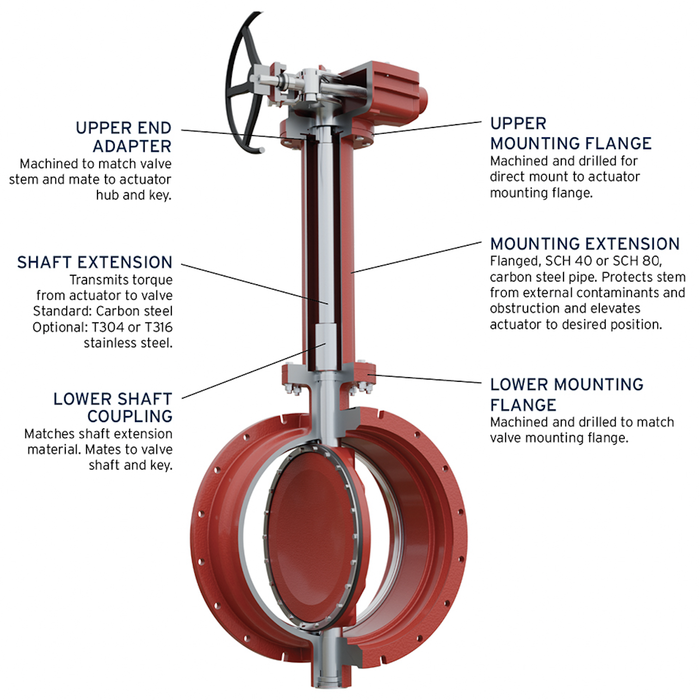
An extended bonnet is an extension of the valve stem used to elevate an actuator assembly from a below grade application. The extended bonnet consists of an outer bonnet body and an inner stem extension, or torque tube, which transfers torque between the valve stem and the actuator.
The outer bonnet body is typically fabricated from a section of steel pipe and two flange adapters to connect the valve to the actuator. The inner stem can be either a single piece stem made from steel round bar, or a multi-piece assembly consisting of steel pipe and machine couplings that interface with the valve stem and actuator.
APPLICATION
Extended bonnets are an ideal choice for applications which require direct burial or submergence of a valve. In these applications, the addition of the bonnet allows the actuator to be installed a set distance away from the valve, providing grade level access to the actuator for operation and easier maintenance. The outer bonnet body also provides protection from the elements, allowing the inner torque tube to rotate free from any debris.
A common example of when an extended bonnet would be used is at the base of a finished (filtered and disinfected) water storage reservoir, or Clearwell. These reservoirs often drain through a network of underground pipe 10 to 20 feet below grade, or “yard piping”, with flow controlled by a butterfly valve at the outlet. Because the butterfly valve typically must also be buried, an extended bonnet allows the actuator to be positioned at grade level, eliminating the need for excavation in the event the actuator needs to be accessed in the future.
CONSIDERATIONS
There are several factors that must be addressed by both the customer and the manufacturer when ordering an extended bonnet. First and foremost, a length requirement must be provided to the manufacturer upon release of an order. This length can be provided as a flange-to-flange dimension of the bonnet extension itself, or as a centerline-of-pipe to centerline-of-handwheel dimension. The contract documents will typically provide this length requirement as a centerline to grade dimension, and it is standard practice to add 30 to 36 inches from grade level to the centerline of the handwheel for the total centerline-to-centerline length requirement.
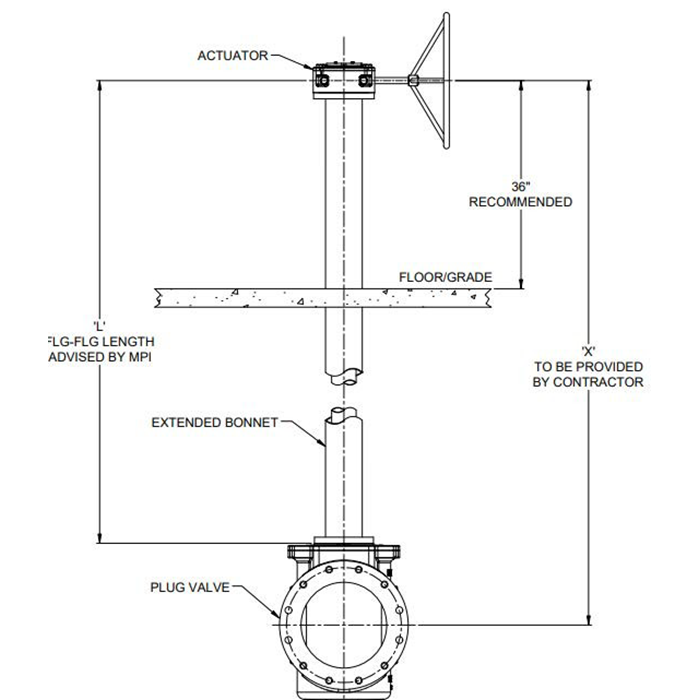
Once this information has been passed along to the manufacturer, the design process can begin. The most important consideration on the manufacturer’s end is torsional deflection due to the amount of torque that must be transferred throughout the length of the extension. The maximum allowable angular deflection in quarter-turn valves is dependent upon the type of valve, whether the valve is position-seated or torque-seated, and the specified actuator’s allowable overtravel.
Referencing AWWA M49, ball and butterfly valves are characterized as position-seated valves, which typically require that the disc or ball is positioned within 1° of the true closed position. AWWA C504 further states that the total deflection of the extension should be less than 3/4° during seating to maintain the closed position. Eccentric plug valves, on the other hand, are characterized as torque-seated valves so there is a little more leeway at the true closed position. M49 suggests a maximum deflection angle within 2° to 3°.
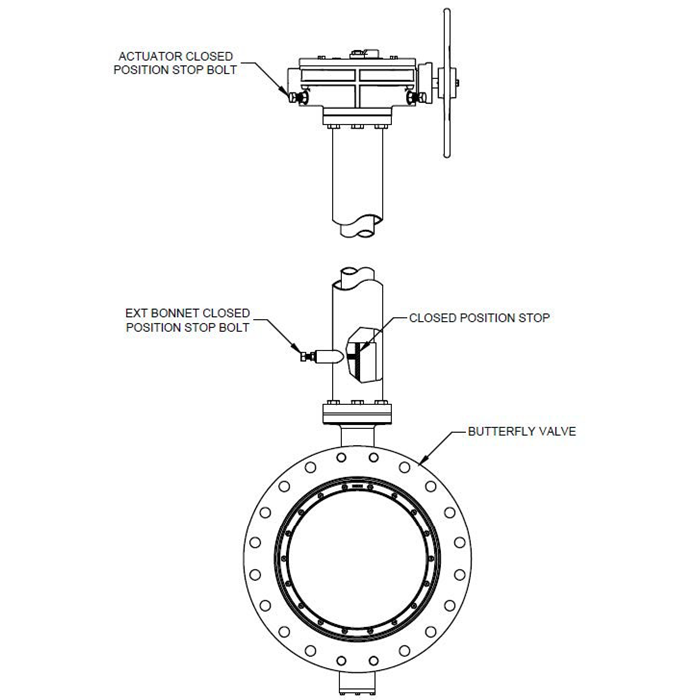
As extended bonnet lengths increase, limiting deflection becomes more challenging due to the increased diameter of pipe that would be required. In these cases, a position stop may be utilized at the valve stem in position-seated valves to accurately position the valve in the true closed position, preventing overtravel.
When position stops are utilized, the bonnet is allowed to deflect to greater angles and would then be limited to the amount of overtravel in the actuator design. Worm gears, for example, are typically designed with 5° of allowable overtravel which means that we can account for a maximum deflection angle of 5° in the extended bonnet with a position stop. However, manufacturers may choose to limit this further with a factor of safety. If allowable overtravel in the actuator is not accurately accounted for, the actuator can reach its travel limit before the valve fully closes.
For torque seated quarter-turn valves, such as an eccentric plug valve, a closed position stop is not required because the seating action limits plug travel. The main requirement is that the allowable overtravel in the actuator is not exceeded at the closed position, and deflection does not exceed 5° at any mid-stroke position per AWWA M49.
CONCLUSION
In summary, extended bonnets provide a practical and reliable solution for below grade valve installations, particularly in buried or submerged environments. By elevating the actuator, they provide direct access while protecting the torque transmitting components, reducing the potential for any costly excavations.
However, achieving a successful installation depends on careful coordination between the engineer and manufacturer — especially in defining the required extension length and ensuring that torsional deflection remains within acceptable limits for the specific valve type. When these factors are properly addressed, extended bonnets offer an efficient and reliable means of maintaining precise valve control in below grade applications.
MPI's extended bonnets are compatible with our full range of valve and water control gate products. Learn more and access technical documents and drawings here.